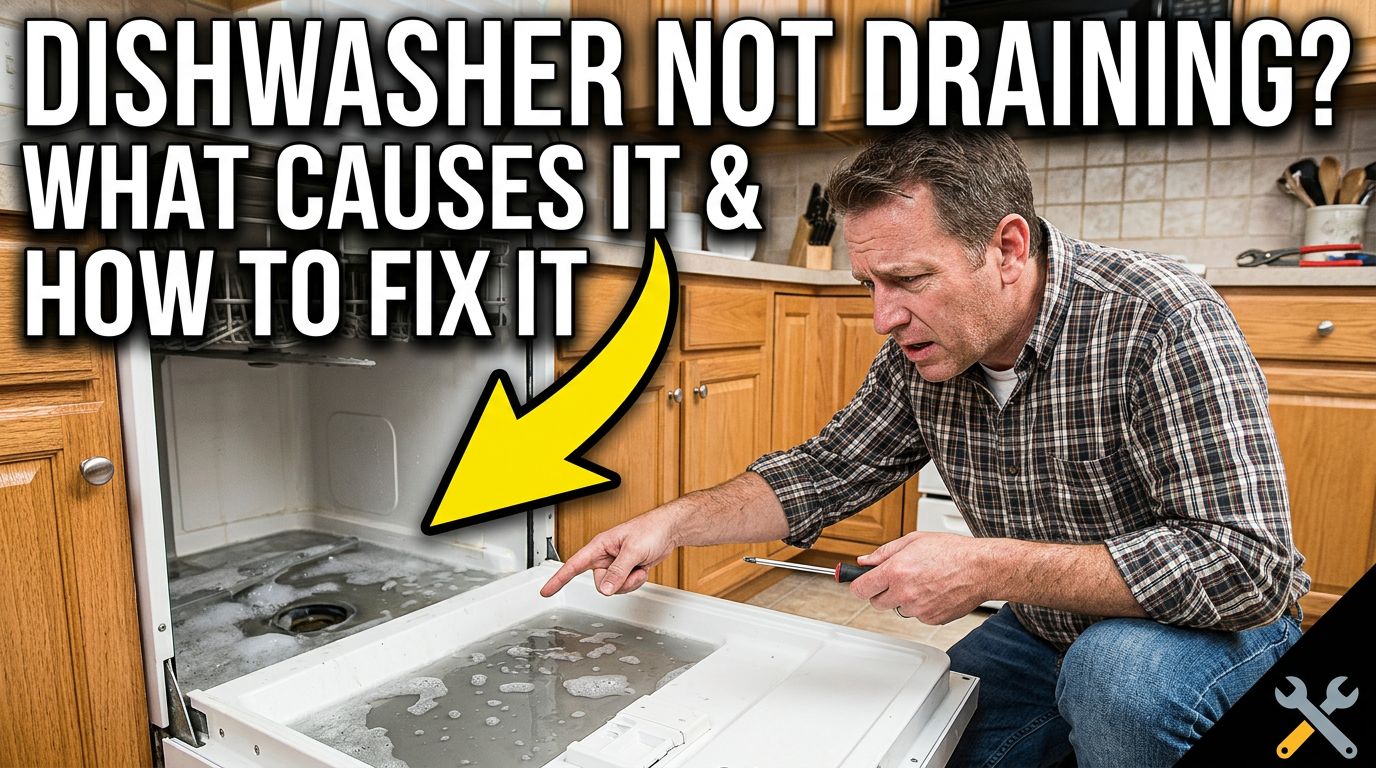
You open the dishwasher after a full cycle and find a puddle of murky water sitting at the bottom. Nobody wants to come home to that, and it usually means something in the drain system needs attention. This guide walks you through every common cause of a dishwasher not draining, what to check first, and how to fix it yourself or know when to call for help.
Most drainage problems come down to a handful of culprits: a clogged filter, a blocked drain hose, or something going on with the garbage disposal connection. At Top Appliance Repair Burnaby, we field calls about standing water in dishwashers regularly, and the good news is that a fair number of these turn out to be simple fixes a homeowner can handle in under an hour. Burnaby homes – especially the older ranchers and split-levels in areas like Edmonds and Metrotown – tend to have dishwashers that have been running for years without a filter cleaning, which makes drainage problems more common than they should be.
That said, there are cases where the pump has given out or the drain line has a deeper blockage, and those do need a professional. The trick is knowing which situation you’re dealing with before you spend money on a service call you may not need.
Key takeaways
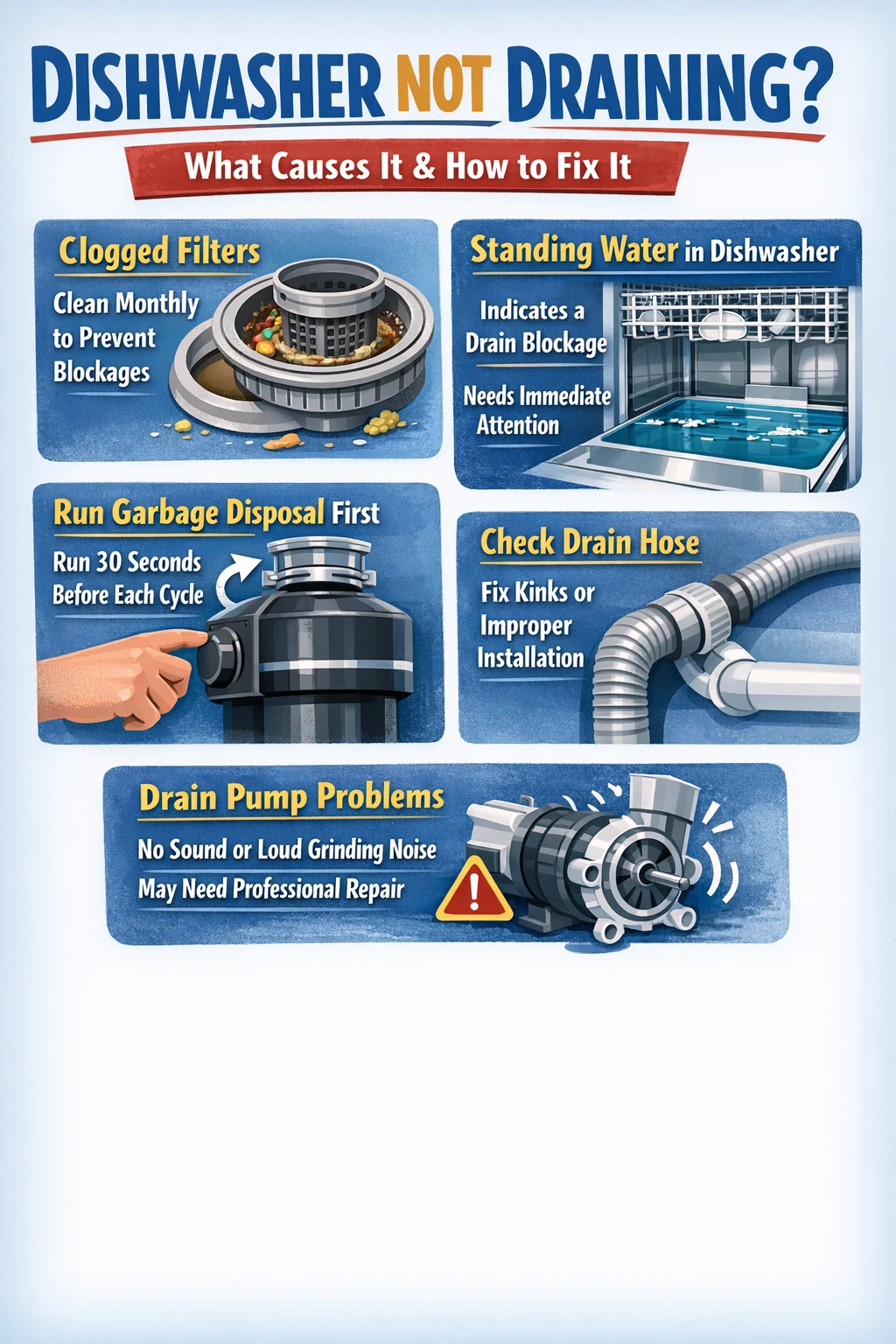
- The most common cause of a dishwasher not draining is a clogged filter – cleaning it monthly can prevent the majority of drainage problems.
- Standing water of an inch or more after a complete wash cycle almost always signals a blockage somewhere in the drain system, not a normal condition.
- A blocked garbage disposal is one of the most overlooked causes – running it for 30 seconds before starting the dishwasher can prevent backups.
- A kinked or improperly installed drain hose can cause intermittent draining failures that are easy to miss and simple to fix once found.
- If the drain pump makes no sound during the drain cycle, or makes a grinding noise, that’s a mechanical failure that requires professional repair.
- Drain hose replacement costs are generally low – an old hose with sediment buildup restricts flow and is worth swapping if it hasn’t been changed in several years.
Why your dishwasher isn’t draining – the real causes
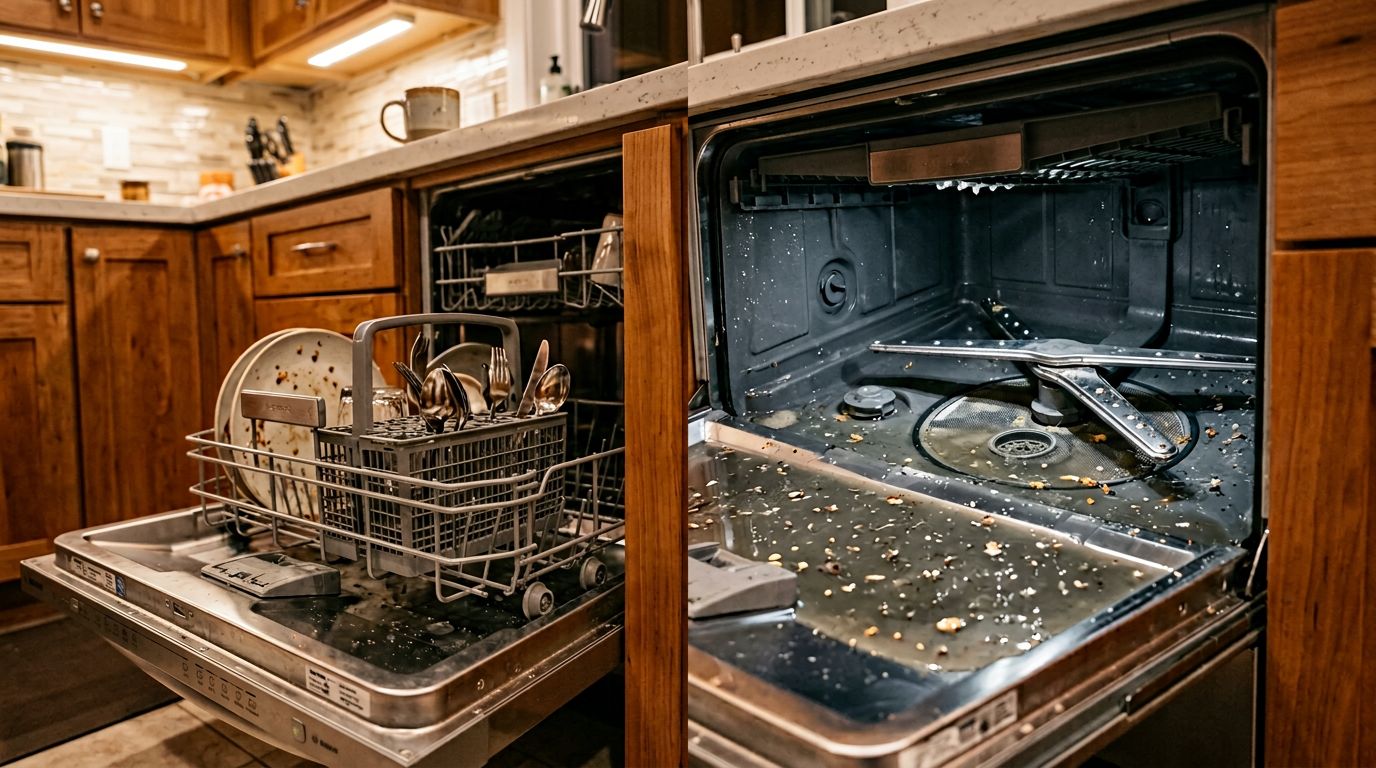
A dishwasher that won’t drain is almost always caused by a blockage somewhere between the drain filter and the sink connection, or by a drain pump that can no longer push water out. The drain system has four main parts working together: the filter, the drain pump, the drain hose, and the connection point at the sink or garbage disposal. When any one of those gets blocked or fails, water has nowhere to go and sits at the bottom of the tub.
The filter is the first place to look. It sits at the bottom of the dishwasher tub and catches food particles, grease, and the occasional piece of paper label that slipped off a container. Over time, that material builds up into a paste-like layer that water simply can’t pass through. Bosch recommends cleaning their filters monthly, and we see the same advice from most major manufacturers – though plenty of homeowners go years without touching it. Tough food particles like popcorn kernels, small bones, or cooked pasta are repeat offenders. One Reddit user spent a full year diagnosing their machine before finding a rib bone stuck in the drain hose. That’s how subtle these blockages can be.
If the filter looks clean, the problem usually lives further down the line. A kinked drain hose is a surprisingly common cause – especially after a kitchen renovation or if something stored under the sink has been leaning against it. The hose can also accumulate grease and sediment on the inside walls over time, slowly narrowing the passage until water can barely get through. And if your dishwasher drains through a garbage disposal, a full or clogged disposal will stop the dishwasher cold. In our experience, this is the one people overlook most often.
How to check and clean your dishwasher filter
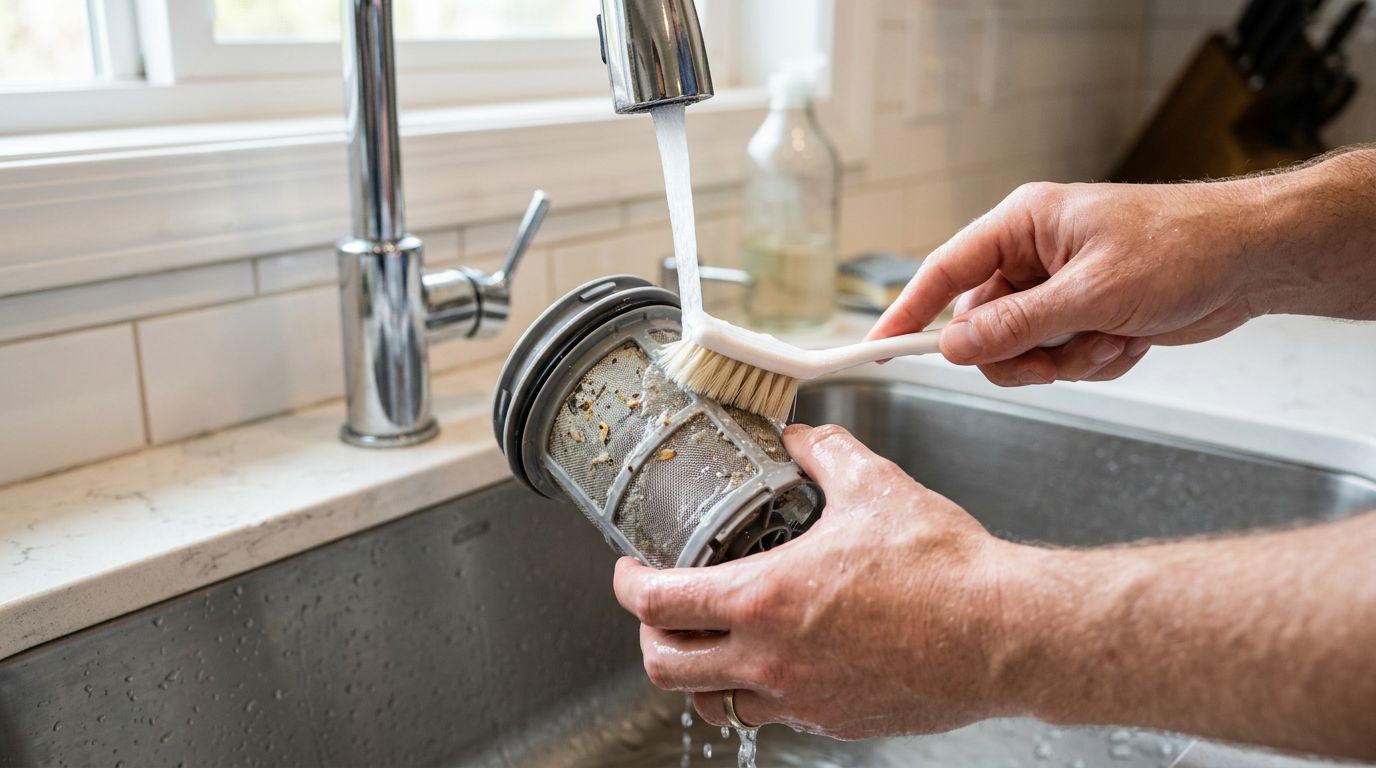
This is the right place to start, and honestly, this fix is more satisfying than it looks. You don’t need tools for most models, and the whole job takes maybe ten minutes.
First, disconnect the dishwasher from power. Pull out the bottom rack completely. At the bottom of the tub, you’ll see the filter assembly – it’s usually located near the base of the bottom spray arm, sometimes tucked into a back corner. Most filters twist counterclockwise to unlock and lift straight out. Some models have a two-part system: a coarse outer filter and a finer mesh inner filter underneath. Check your owner’s manual if you’re not sure, since pulling the wrong thing the wrong way can cause damage.
With the filter out, take it to the kitchen sink and rinse it under hot water. Use an old toothbrush to scrub off anything stuck in the mesh – food debris, grease, or mineral buildup. Don’t use a wire brush or anything abrasive; the mesh is finer than it looks and easy to damage. If you’re dealing with a heavy buildup, a soak in warm soapy water for a few minutes loosens things up nicely. Once it’s clean, reinstall it firmly. A loosely seated filter can let debris into the pump, which creates a bigger problem than the one you started with.
While the filter is out, take a look into the pump area below. Sometimes a small piece of broken glass, a toothpick, or even a chip of ceramic will make it through the filter and jam the impeller. If you see anything in there, remove it carefully – wear gloves, because broken glass is a real hazard here. One homeowner found a triangle of broken glass that had jammed their drain pump impeller and was getting the machine for next to nothing because of it. It happens more than you’d think.
Checking the garbage disposal and air gap
Once you’ve dealt with the filter, the next stop is the garbage disposal connection – assuming your kitchen has one. This is the second most common source of dishwasher drain problems, and it’s often the quickest fix.
Run the disposal with cold water for a good 30 seconds before you do anything else. A disposal that’s full of food debris acts as a dam in the drain line – the dishwasher pump pushes water toward it and gets nowhere. Making a habit of running the disposal briefly before every dishwasher cycle prevents a lot of these calls. If you recently had a new disposal installed, there’s one more thing to check: the knockout plug. New disposals come with a plastic plug inside the dishwasher drain inlet. If the installer forgot to remove it – and this happens more than anyone admits – your dishwasher has literally nowhere to drain. Drilling or punching out that plug solves the problem immediately.
The air gap is another component worth inspecting. Not every installation has one – some setups use a high drain loop instead – but if you have a small cylindrical fixture mounted on your countertop or the back of your sink deck, that’s your air gap. Its job is to prevent dirty water from siphoning back into the dishwasher. It can collect debris over time, especially rice, small food particles, and soap scum. Pop the cap off, look inside, and clean out anything you find with a small brush or a piece of wire. A clogged air gap can cause water to back up into the sink when the dishwasher drains, which is a tell-tale sign something is blocked downstream.
We get calls about this fairly often from homes in the Brentwood area, where the kitchen plumbing setups in some of the mid-century builds tend to use older drain configurations that need a bit more maintenance attention than modern installations.
Inspecting the drain hose
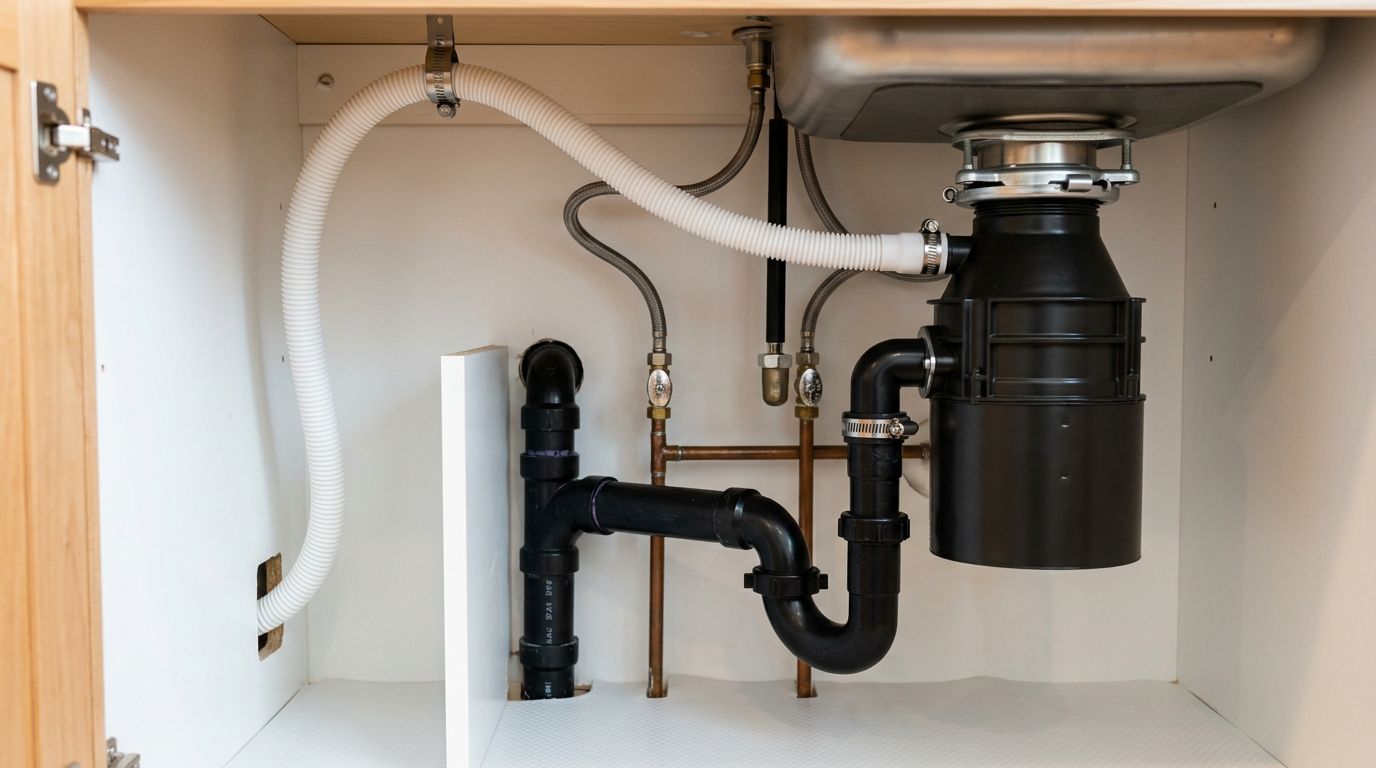
If the filter and disposal are both clear and the machine still won’t drain, it’s time to look at the drain hose. This is slightly more involved but still well within DIY territory.
The drain hose runs from the bottom of the dishwasher to either your garbage disposal or the sink drain. It’s located either under the sink or behind the dishwasher itself. Gently pull the dishwasher out from its cabinet space – just a few inches is usually enough – and trace the hose along its full length. Look for kinks, sharp bends, or any spots where something under the sink may have pushed against the hose and flattened it. A kinked hose was the culprit in one Reddit thread where a homeowner had already replaced the entire dishwasher before figuring out the problem. The new machine had the same issue because the hose just got bent again during reinstallation.
To check for an internal blockage, disconnect the hose from the sink or disposal end and place it in a bucket. Try to run a drain cycle and see if water comes out. If nothing flows, the hose is clogged. A bottle brush can clear most blockages. For grease buildup, a baking soda and vinegar flush works well for mild clogs – pour it in, let it sit for 10 minutes, then flush with hot water. For more stubborn buildup, a drain cleaning solution does the job faster. If the hose is old and has visible sediment or cracks, replace it. New dishwashers come with a white corrugated drain hose for a reason – older hoses kink more easily and accumulate buildup on the inner walls over time.
One installation detail worth knowing: the drain hose needs to form a high loop under the counter, or connect to an air gap, to prevent dirty water from draining back into the machine. If the hose runs low the whole way, or if it was installed backward with a built-in check valve in the wrong direction, the dishwasher may drain slowly or incompletely. It’s worth confirming the installation matches your manufacturer’s instructions, especially after any recent kitchen work. For more detail on proper drain hose installation, Energy.gov’s appliance installation guidance is a useful reference point.
When the problem is the drain pump
If you’ve cleaned the filter, cleared the disposal, and confirmed the hose is straight and unblocked, and the machine still sits there with standing water after a cycle, the drain pump may be the issue.
The drain pump is the motor that forces water out of the tub and through the hose. When it fails or gets jammed by a foreign object, you’ll usually hear one of two things: either complete silence during what should be the drain cycle, or a humming sound that doesn’t go anywhere. That hum means the motor is getting power but something is stopping the impeller from turning. On some models, pressing and holding the cancel button triggers a forced drain cycle – if you press it and hear nothing at all, that’s a stronger sign the pump has failed.
Replacing a drain pump is doable for a confident DIYer – there are good YouTube videos for most brands and the part itself can often be found for $40 to $80 on Amazon or through the manufacturer. On an LG dishwasher, for example, it’s been reported as a $40 part. That said, getting to the pump usually means pulling the machine out, flipping it, and disassembling the base, so it’s not a quick job. If you’re not comfortable with that, or if the pump replacement doesn’t solve the problem, it’s time to bring in a technician. Bosch’s own support documentation, for instance, recommends calling Bosch Customer Support at 1-800-944-2904 when filter and pump checks don’t resolve drainage – a good reminder that manufacturers themselves expect some of these issues to need professional diagnosis. You can also review Bosch’s dishwasher support resources for brand-specific guidance.
Frequently asked questions
These are the questions we hear most often when homeowners are dealing with a dishwasher backing up or not draining properly. If your situation matches one of these, there’s a good chance the answer below will sort it out.
Is it normal to have some water at the bottom of the dishwasher?
A small amount of standing water in the filter area is normal and actually intentional – it keeps the seals from drying out. On models without a fine filter, one to two cups of water covering the bottom of the tub is considered normal by most manufacturers. What’s not normal is an inch or more of water pooling across the full bottom of the tub after a complete cycle. That indicates a blockage or drainage failure that needs attention.
Why does my dishwasher back up into the sink?
When dishwasher water backs up into the sink, the problem is almost always downstream from the dishwasher itself – usually a blocked garbage disposal, a clogged air gap, or a partial clog in the shared drain line. If your kitchen sink is also draining slowly on its own, the problem is almost certainly in the shared drain line rather than the dishwasher. Running the garbage disposal to clear any food debris is the first thing to try. If the sink drain is slow regardless of the dishwasher, a plumber’s snake or professional drain cleaning is the next step – this is beyond what dishwasher troubleshooting can solve.
Can I reset my dishwasher to fix a draining problem?
Sometimes, yes. If the dishwasher was interrupted mid-cycle – by a power outage, for instance, or someone opening the door at the wrong time – it may not have completed the drain phase, leaving water behind. Running a new cycle without interrupting it often clears this up. Pressing and holding the cancel button on most models triggers a forced drain. If that doesn’t produce any sound or result, the issue is physical rather than a software hiccup, and you’ll need to work through the filter and hose checks described above.
How often should I clean my dishwasher filter to prevent clogs?
Once a month is the standard recommendation from most manufacturers, and it’s realistic. A quick rinse under the tap with a soft brush takes about five minutes. If you’re running the dishwasher daily with heavily soiled dishes, or if you rarely scrape food off plates before loading, you may want to check it every two to three weeks. Neglecting the filter is by far the most common reason we see standing water in dishwasher repair calls – it’s a small habit that prevents a recurring headache.
What if none of the DIY fixes work?
If you’ve cleaned the filter, run the disposal, checked the hose for kinks and clogs, and confirmed the air gap is clear, and the machine still won’t drain, the problem is most likely a failed drain pump or a deeper plumbing issue. A drain pump that makes no noise during the drain cycle, or that grinds instead of humming, has likely failed mechanically. Similarly, if multiple drains in your home are running slow at the same time, the problem is in your home’s drain lines, not the dishwasher. Both situations call for a professional. For a helpful overview of how dishwasher drain systems are designed to work, Consumer Reports’ appliance guides offer solid background on what to expect from different brands and setups.
Wrapping up
A dishwasher not draining is almost always fixable – start with the filter, work your way through the disposal and hose, and you’ll solve the problem the majority of the time without spending a dollar. Keep the filter clean monthly, run the disposal before each cycle, and inspect the drain hose once a year for kinks or buildup, and these issues become rare rather than recurring. If you’ve worked through all of that and still have standing water in dishwasher after a full cycle, or if the pump is making sounds it shouldn’t, that’s when a technician can save you time and further frustration. At Top Appliance Repair Burnaby, we handle dishwasher repair and other appliance issues across Burnaby and the surrounding area – including stove repair, fridge repair, and washer repair for homeowners who’d rather not spend their weekend chasing down a fault code. Give us a call and we’ll help you figure out exactly what’s going on and the most straightforward path to fix it.