You open the fridge for a cold drink and it’s barely cooler than the counter nobody wants that, especially when you’re not sure if it’s a quick fix or a several-hundred-dollar repair bill. This guide walks you through the most common reasons a refrigerator stops cooling properly, what you can check yourself right now, and when it’s time to call in help. Burnaby homes run their fridges hard. Between the mild but damp winters and the warm summers, temperature swings in kitchens and garages can put extra stress on appliances that were never designed for those conditions. At Top Appliance Repair Burnaby, we hear from homeowners dealing with warm fridges on a regular basis, and the good news is that a surprising number of these calls turn out to be simple fixes that don’t require a technician at all. That said, not every warm fridge is a DIY situation. Some problems sit firmly in the ‘call a professional’ category, and trying to push past them without the right tools can make things worse. Let’s work through this step by step, starting with the easy stuff.
Key takeaways
- Your fridge should stay between 33°F and 40°F (with 37°F being the sweet spot) for food to stay fresh and safe.
- Many cooling problems come down to dirty condenser coils, blocked air vents, or a door seal that isn’t closing properly all things you can check in about 15 minutes.
- After adjusting temperature settings or doing a manual defrost, give the fridge up to 24 hours to fully stabilize before assuming something is still wrong.
- If the compressor runs constantly without cooling, or if you hear clicking on-and-off cycles, those are signs of a deeper mechanical issue that needs a technician.
- Ice buildup on the back wall of the freezer often points to a failed defrost component, which is a common and repairable problem but not a DIY one for most people.
- Older fridges generally those past the 10-year mark may not be worth repairing if the compressor or sealed system has failed, since parts alone can run over $300.
Start here: the checks that solve most cases
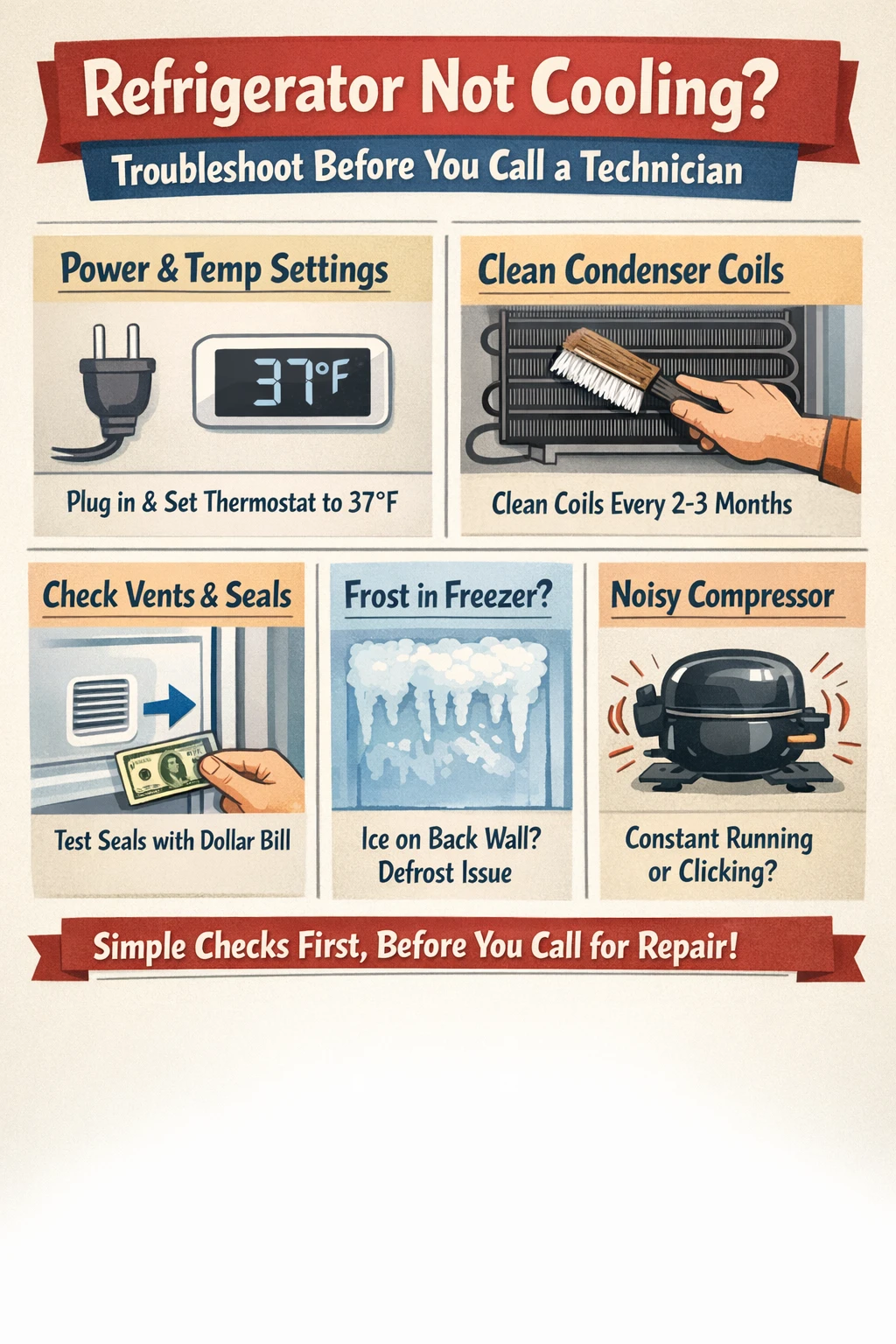
When a fridge stops cooling, the most likely culprits aren’t the dramatic ones. Before anything else, check that the fridge is actually plugged in and that the circuit breaker hasn’t tripped. It sounds obvious, but a kicked breaker or a partially-pulled plug is behind more service calls than most people would guess. Next, look at the thermostat settings. The controls are easy to bump accidentally, especially in busy households where kids or grocery bags brush past them. The recommended setting for the fridge compartment is 37°F (or the equivalent on dial-type controls). If the freezer and fridge have separate controls, check both. A change in temperature settings can take up to 24 hours to show up, so don’t panic immediately if things don’t cool down within the hour. Also worth a quick check: when did you last add a lot of food? Loading a fridge with warm groceries or hot leftovers temporarily pushes the internal temperature up. Opening the door frequently has the same effect. If the fridge was just restocked, give it time before assuming something is broken. 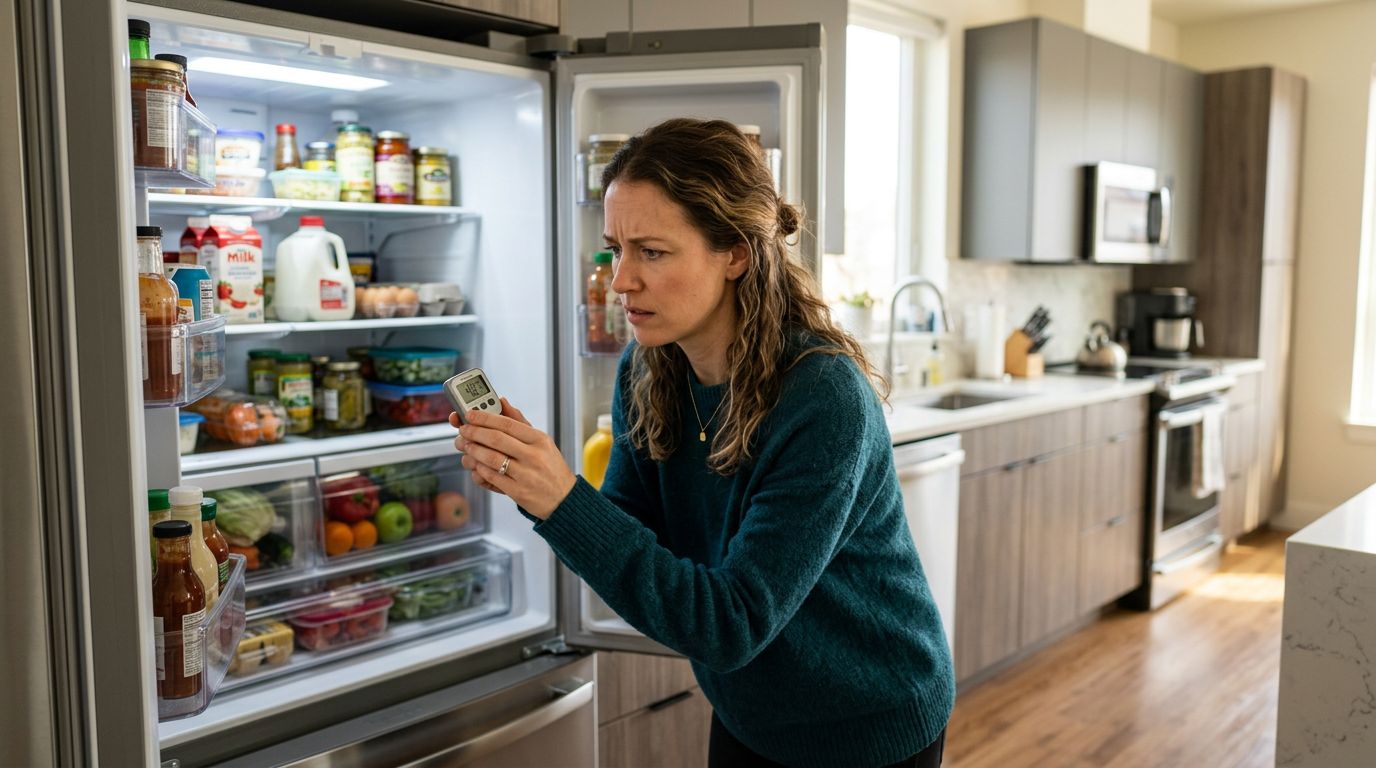
The condenser coils probably the most overlooked maintenance task
Here’s something a lot of homeowners don’t realize. The condenser coils on your fridge need to be cleaned regularly, and most people never do it once in the life of the appliance. These coils usually found along the bottom or the back of the unit release heat as part of the cooling cycle. When they get coated in dust, pet hair, and grease, that heat has nowhere to go, and the fridge works harder and harder while cooling less and less. 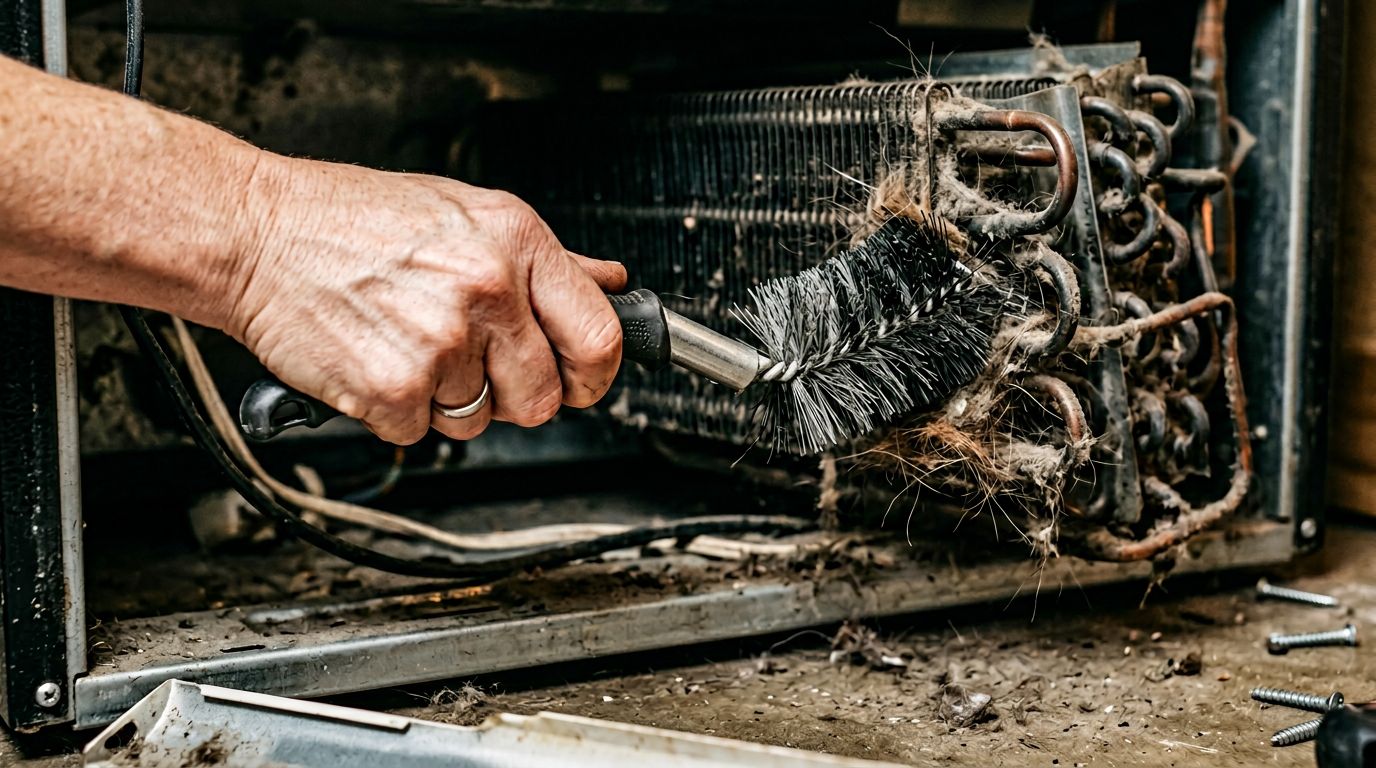 In homes with pets or kitchens that see a lot of cooking, the coils can clog up fast. Cleaning every two to three months is a reasonable target for those situations. For a typical household without pets, once or twice a year is usually enough. To clean them, unplug the fridge first. Pull it away from the wall, or remove the lower front kick panel depending on your model. A coil brush and vacuum do most of the work. The U.S. Department of Energy notes that clean condenser coils help refrigerators run more efficiently, which also shows up on your hydro bill over time. We see this particular issue a lot in older homes around Brentwood and Metrotown, where fridges have been running for years without this basic maintenance. A good coil cleaning sometimes makes the difference between a fridge that works and one that seems like it’s dying.
Air vents, door seals, and the basics of airflow
Refrigerators cool by circulating air, and anything that blocks that circulation will cause temperature problems. The air vents inside the fridge and freezer compartments are the first thing to check. If food items are pushed up against them, cold air can’t flow through properly. This is especially common in overstuffed fridges where items get rearranged constantly. The fix here is simply to reorganize. Leave some breathing room around the vents, particularly the ones at the back of the freezer. Overpacking a fridge doesn’t just block vents it also forces the compressor to run longer to compensate, which wears on the appliance. Door gaskets are the next thing to look at. These are the rubber or magnetic seals that run around the edge of the door. Over time they collect crumbs, get compressed, or start to crack. A gasket that doesn’t seal properly lets cold air leak out constantly, and the fridge never quite catches up. A simple test: close the door on a dollar bill. If you can pull the bill out without any resistance at all, the seal isn’t doing its job. Clean dirty gaskets with warm soapy water and a sponge. If a section has compressed or pulled away from the door frame, you can often gently press it back. A torn or cracked gasket needs to be replaced, which is a job most technicians can handle quickly.
Don’t forget to check if it’s level
A fridge that’s slightly out of level can cause the doors to swing open on their own or fail to seal fully on one side. Use a level on the floor under the appliance to check. Most fridges have adjustable front feet that you can turn by hand or with a wrench. It takes five minutes and sometimes makes a surprising difference.
Ice buildup and defrost problems
Here’s a situation we come across regularly, and it’s one that confuses a lot of homeowners. The freezer has frost or ice building up on the back wall, and the fridge section isn’t cooling well. People sometimes assume the fridge is broken because it’s warm, but the actual cause is an excess of ice not a lack of cold. What’s happening is that the ice builds up around the evaporator coils (the coils inside the freezer that actually do the cooling). Once enough ice accumulates, the fan can’t pull air over the coils anymore, and the fridge section stops receiving cold air. The freezer might still feel somewhat cold from the ice itself, but true cooling is compromised. 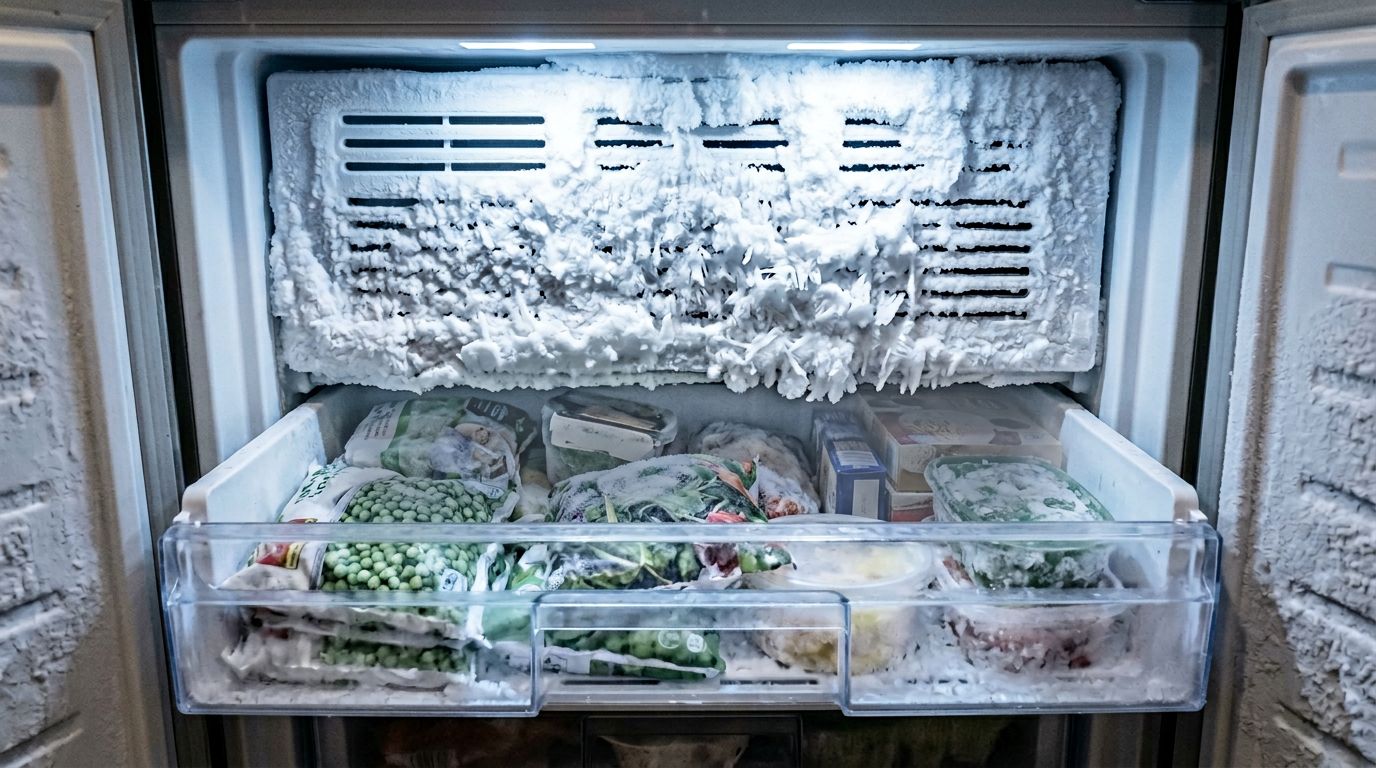 This usually points to a problem with the automatic defrost system. Refrigerators are designed to defrost themselves around four times every 24 hours, using a defrost heater to melt any buildup before it causes problems. If the defrost timer, defrost heater, or bi-metal thermostat fails, ice accumulates unchecked. You can get a sense of whether this is the issue by doing a manual defrost: unplug the fridge, remove the food, and leave the doors open for 24 to 48 hours to let everything melt. If the fridge cools normally afterward for a week or so before the problem returns, that’s a strong sign the defrost system needs repair. The manufacturer documentation from LG notes that error codes related to frost buildup or freezer door sensing can often be traced back to defrost system faults, and a reset alone won’t solve a recurring issue.
What the compressor is actually telling you
The compressor is the heart of the cooling system. It’s the component that compresses refrigerant and starts the whole cooling cycle. Some compressor noise is completely normal a gentle hum or occasional hiss is just the system working. The warning signs are different. A compressor that runs constantly without the fridge getting cold is a problem. So is one that cycles in a pattern of starting, clicking, and stopping every minute or two that click is usually the start relay failing, which is a relatively inexpensive fix if caught early. A compressor that’s too hot to hold your hand against, or one that causes the breaker to trip, is showing signs of failure. If the compressor is genuinely dead and not just a bad start relay, repair costs get steep fast. Both the compressor and evaporator coils can run over $300 each in parts alone, and those components are welded into the refrigerant system, requiring specialized tools and handling to replace. At that point, the age of the fridge matters a lot. A 12-year-old fridge with a failed compressor is often not worth the repair bill.
The quick reset and why it sometimes works
Some cooling issues clear up with a simple power reset, particularly on fridges with electronic controls or those that have been through a power outage. Unplug the fridge (or flip the breaker off) and leave it off for five to ten minutes. Plug it back in and set the temperature to 37°F for the fridge and 0°F for the freezer. Allow 24 hours for temperatures to stabilize fully. This works because minor glitches in the electronic control board can sometimes cause the fridge to misread temperatures or fail to start the cooling cycle correctly. It’s the refrigerator equivalent of restarting your router. It won’t fix a mechanical problem, but it’s always worth trying first and takes almost no time. If the fridge has a display showing an error code, look that code up in your owner’s manual or on the manufacturer’s support site before doing anything else. Many modern fridges will tell you exactly what’s wrong if you know how to read the code.
When the location is the problem
One thing that doesn’t get enough attention is where the fridge is installed. Refrigerators need clearance around them to release heat properly at minimum, about half an inch on the sides and one inch at the back. Push a fridge too tight against a wall or into a narrow cabinet, and it runs hotter than it should. A bigger issue we see in parts of Burnaby with detached garages and older suites: people put a second fridge in an uninsulated space. Standard residential refrigerators aren’t designed to work properly in environments where temperatures drop below about 55°F or spike in summer heat. The thermostat can malfunction in extreme cold, and in summer heat, the unit can’t shed heat fast enough. If your garage fridge is struggling, its location may be working against it. We get calls from the Edmonds area and South Slope about this fairly often, usually when the seasons turn. Sometimes repositioning or insulating the space is all it takes.
Frequently asked questions
These are the questions that come up most often when homeowners are trying to figure out what’s going on with a warm fridge. Some have simple answers; others depend on what you find when you look.
Why is my freezer working but my fridge compartment isn’t cold?
This usually points to one of a few things: a blocked or frozen air vent between the freezer and fridge sections, a stuck or failed evaporator fan, or a damper control that’s stuck in the closed position. The damper is a small flap that controls how much cold air from the freezer passes into the fridge. If it’s stuck closed, the fridge section starves for cold air even though the freezer is fine. A faulty thermistor (the sensor that reads internal temperature) can also cause this, because the control board thinks the fridge is already cold when it isn’t. Most of these repairs require a technician.
How do I know if my fridge door seal is causing the problem?
The dollar bill test is the easiest method. Close the door on a folded dollar bill at different points around the seal. If the bill slides out with no resistance, that section of the gasket isn’t sealing. A cold, working fridge with a bad seal will also show condensation or frost near the door edges. Clean the gasket thoroughly first, since a dirty seal often won’t sit properly against the door frame. If cleaning doesn’t fix it, the gasket needs replacing.
My fridge was cooling fine and then suddenly stopped. What happened?
Sudden cooling loss with no warning is often the compressor or the start relay. If the fridge is completely silent (no hum, fan, or vibration from the compressor area), the compressor may not be running at all. Try unplugging for a minute, then plugging back in you should hear or feel the compressor attempt to start within 30 to 60 seconds. If it tries to start, clicks, and then goes quiet repeatedly, that’s the start relay pattern and it’s worth having a technician assess. If the compressor starts normally but the fridge still won’t cool, a refrigerant leak is possible, which requires professional diagnosis and handling.
Is it worth repairing an older fridge, or should I replace it?
The general rule of thumb: if the repair cost is more than half the price of a comparable new fridge, and the appliance is already past ten years old, replacement usually makes more financial sense. A Natural Resources Canada energy efficiency resource notes that newer fridges use significantly less energy than models from a decade ago, so even setting aside repair costs, the operating savings from a new unit can be meaningful over time. That said, if the fix is something straightforward like a start relay or a door gasket, repair makes obvious sense regardless of age.
What does it mean if my fridge is running constantly?
A fridge that never cycles off is working too hard. Common causes include a dirty condenser coil, a bad door seal letting warm air in, a thermostat set too low, or a compressor struggling to maintain temperature. It can also happen temporarily if the fridge was just loaded with food or if the kitchen is very warm. If it’s been running non-stop for more than a few hours under normal conditions, go through the basic checks coils, seals, airflow, clearance. If those all check out, have a technician take a look at the compressor and refrigerant level.
Wrapping up
Most fridge cooling problems come down to a handful of common causes: dirty condenser coils, blocked vents, a door seal that isn’t doing its job, or a thermostat that got bumped. Work through those basic checks before assuming the worst. Give the fridge 24 hours after any adjustment to see if things improve. If ice buildup in the freezer is part of the picture, that defrost problem needs attention before it cycles back. And if the compressor is making unusual sounds, running non-stop, or not running at all, that’s the point where professional diagnosis is the right call. At Top Appliance Repair Burnaby, we handle fridge repair, freezer repair, and all kinds of appliance issues across Burnaby and the surrounding area. If you’ve worked through the steps above and still aren’t sure what’s going on, give us a call and we’ll help you figure out whether it’s a fix or a replacement.