Your washing machine stopped spinning, and now you’re staring at a drum full of soaking wet clothes with nowhere to go. This guide walks you through the most common reasons it happens, what you can check yourself, and when it’s time to call in a professional.
A washing machine that won’t spin is one of those problems that sounds minor until you’re wringing out a soaked sweater by hand at 10pm. In Burnaby, where many homes run older appliances through long, wet winters, this is actually one of the more common service calls we see. Moisture, hard use, and machines that have been running for a decade or more all add up.
At Top Appliance Repair Burnaby, we handle washer issues regularly across Burnaby and the surrounding area. In our experience, a good chunk of spin problems turn out to have a straightforward cause – something you can fix yourself in 20 minutes. But some jobs require real diagnostic work and the right parts. Knowing which is which saves you time and money.
Key takeaways
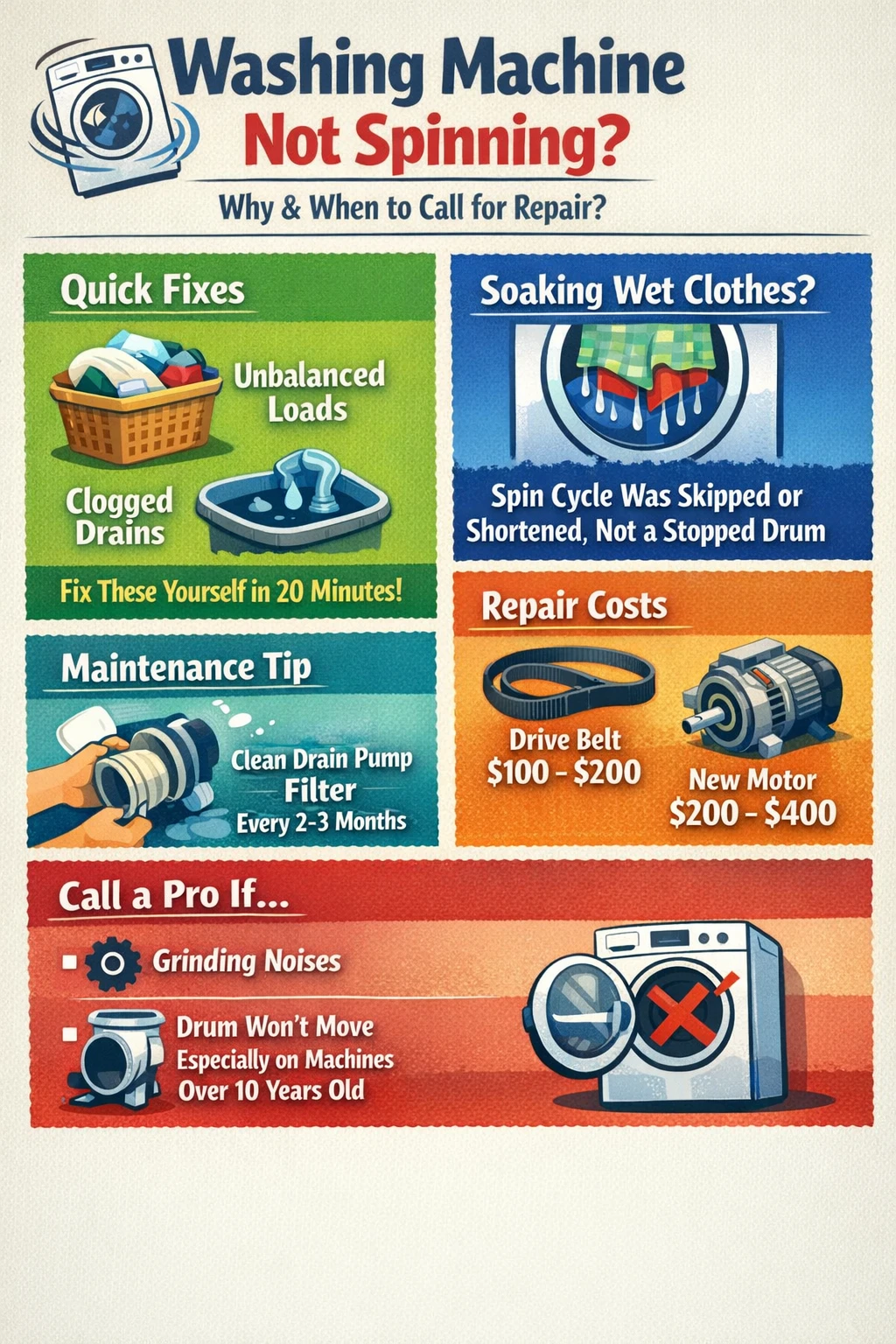
- Most spin failures trace back to one of a handful of causes: an unbalanced load, a clogged drain, a faulty lid switch, a worn drive belt, or a failed motor component.
- Clothes that come out soaking wet after a full cycle often mean the machine completed the wash but skipped or shortened the spin – this is a different problem than a drum that doesn’t move at all.
- Repairing a burned-out washer motor typically runs $200 to $400; a broken drive belt usually costs $100 to $200; and drainage issues can often be resolved for $50 to $150.
- Cleaning the drain pump filter every two to three months can prevent many spin cycle problems before they start.
- If your washer is grinding loudly, stopping mid-cycle repeatedly, or the drum won’t move at all, that’s a sign the problem has moved past DIY territory.
- A machine that’s more than 10 years old and showing multiple symptoms at once may cost more to repair than it’s worth – get a professional assessment before committing to parts.
Why your washing machine isn’t spinning
The most common reason a washing machine won’t spin is also the easiest to fix: the load is unbalanced or the machine is overloaded. When the drum detects too much weight on one side, most modern washers will slow down or stop the spin cycle entirely as a safety measure. Try opening the machine, redistributing the clothes evenly around the drum, and running a spin-only cycle to see if that clears it up.
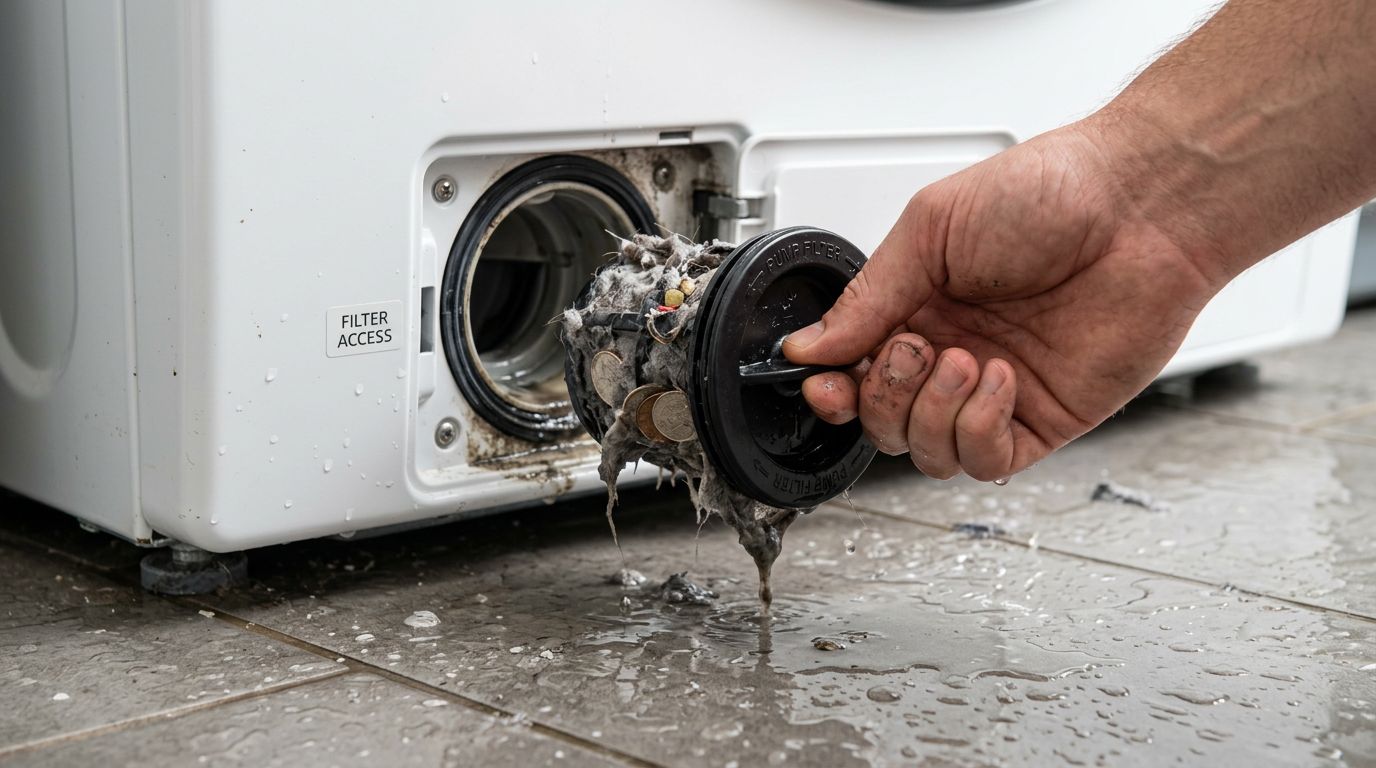
If the load looks fine, the next thing to check is drainage. A washer that can’t drain properly won’t spin – it’s that simple. The machine’s sensors detect standing water and hold the spin cycle until the tub is clear. Inspect the drain hose at the back for kinks or clogs. For front-load washers, there’s usually a small access panel near the bottom where you can reach the pump filter. That filter collects lint, coins, and other debris, and a blocked one will stop drainage cold. Pull it out, clean it, and try again.
Beyond those two, the causes start getting more mechanical. A door or lid that isn’t latching properly will prevent the spin from engaging – the machine won’t run with the door open, and a failing latch can mimic that condition even when the door looks closed. Wrong cycle settings matter too. Delicate and hand-wash cycles use very low spin speeds by design, so clothes coming out wetter than expected isn’t always a malfunction. Check your settings before assuming something is broken.
The mechanical problems that need closer attention
Once you’ve ruled out the simple stuff, you’re into the mechanical causes. These are still diagnosable, but they usually involve taking the machine apart – or at least knowing what to listen for.
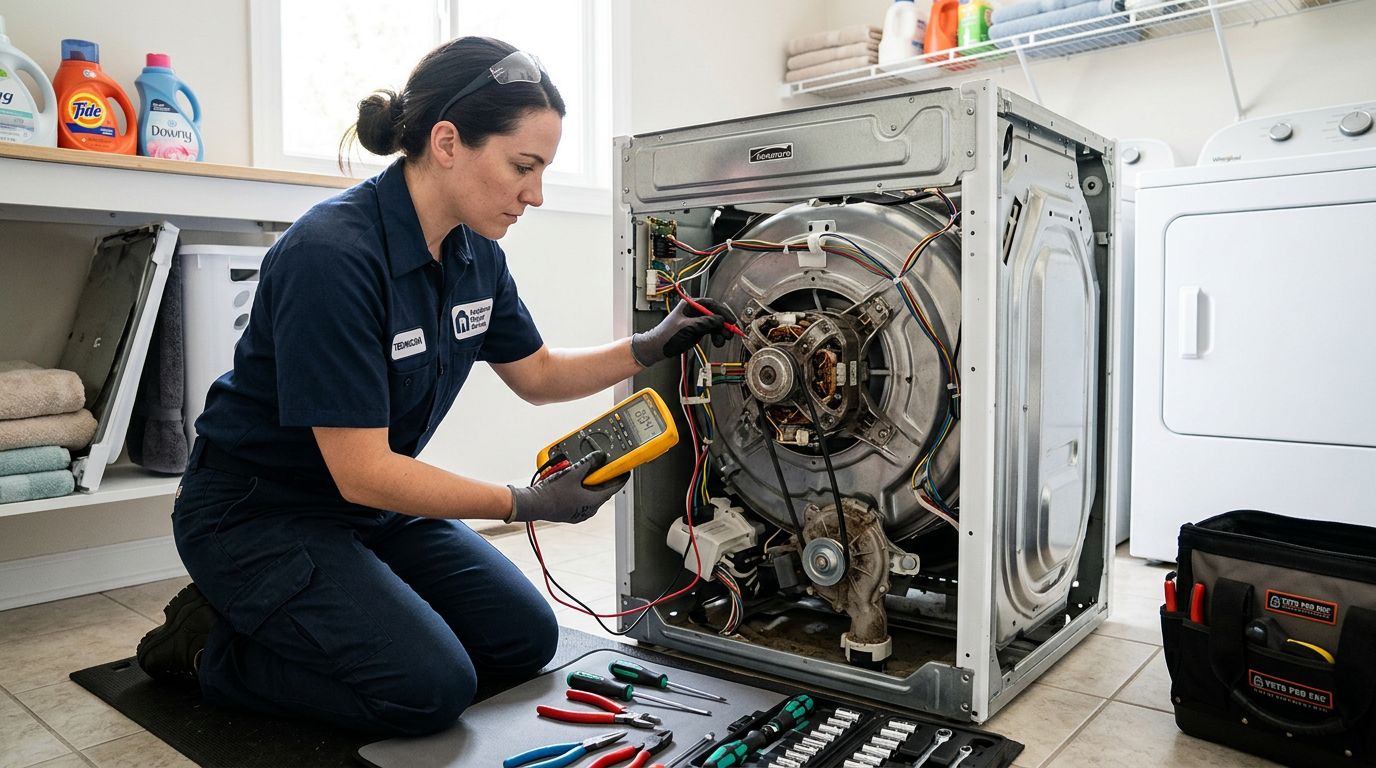
A worn or broken drive belt is a common culprit in older top-load machines. The belt connects the motor to the drum, and when it stretches, slips, or snaps, the drum simply stops turning even though everything else keeps running. You’ll often hear squealing or a grinding noise before it goes completely. The fix means cutting power, pulling off the back panel, and replacing the belt – manageable for a confident DIYer, but easy to get wrong if you haven’t done it before. Replacement parts typically run the job to around $100 to $200 including labor if you go to a technician.
In older top-load washers, there’s also a component called the motor coupling – a small plastic and rubber piece that links the motor to the transmission. It’s designed to break under stress to protect the motor, which means it actually sacrifices itself. If it’s gone, the motor runs but nothing moves. You’ll hear the motor humming with no drum movement. It’s a cheap part, but getting to it takes some disassembly.
Front-load washers have their own set of issues
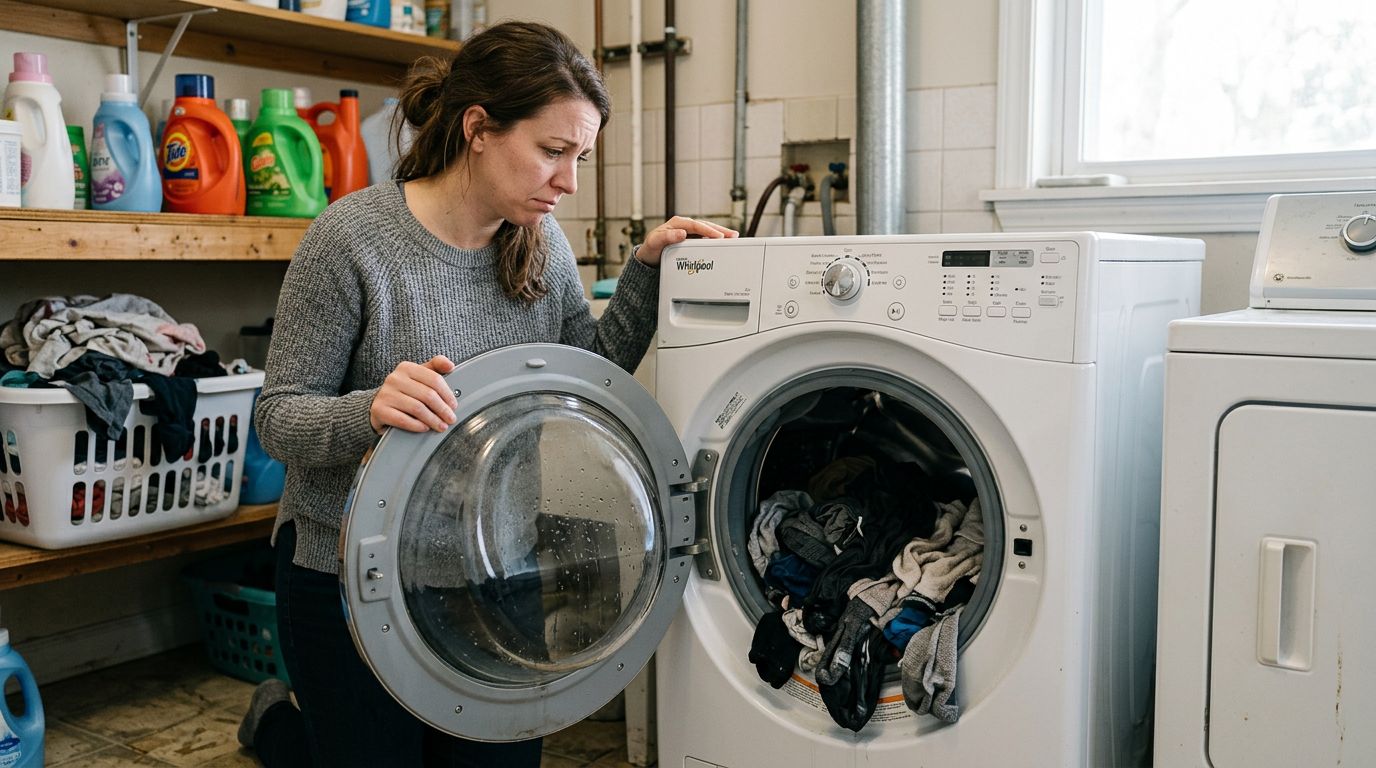
Front-load machines are generally more efficient but have a few failure points specific to their design. Drum bearings are a big one. The bearings let the drum spin smoothly inside the tub, and when they wear out, you’ll notice a rumbling or grinding noise that gets louder over time. Eventually the drum either spins unevenly or stops altogether. Bearing replacement is one of those jobs that’s technically possible as a DIY project, but realistically it means near-complete disassembly. Most people call a pro for this one, and the cost usually runs $200 to $400.
The door lock mechanism is another common front-loader issue. The machine won’t spin unless it detects that the door is fully latched and locked. A failed door lock sensor – or a lock that’s physically damaged – will keep the spin cycle from engaging even if the door is physically shut. Sometimes you can clean the latch contacts and restore function. Other times the whole mechanism needs replacing, which is a $100 to $200 repair.
We see this fairly often in Metrotown-area condos, where front-load washers are the standard choice for tighter laundry closets. The door seal and latch take a lot of wear when machines are stacked or used heavily in smaller spaces.
Motor and control board problems
This is where things get genuinely complicated. If the drum jerks briefly and stops, or the motor hums but produces no spin, you may be looking at a failed motor, a motor capacitor problem, or a faulty control board.
Older machines that use a start capacitor will sometimes fail in exactly this way – the motor tries to start, catches briefly, and then quits. A capacitor is a relatively inexpensive part, but diagnosing it correctly requires a multimeter and some comfort with electrical components. Swapping a capacitor on an accessible motor is a legitimate DIY repair if you know what you’re doing. If you don’t, leave it alone.
Newer machines, particularly inverter-drive models (Samsung’s digital inverter washers are a common example), don’t use capacitors at all. They rely on a motor driver board – a circuit board that controls motor speed and direction. When that board fails, the drum won’t spin and you’ll often see an error code on the display. Replacing the whole board is the usual fix; component-level repair is possible but challenging because many boards are coated in a potting compound that makes individual component access difficult. According to LG’s support documentation, error codes on the display are one of the first things to check when the drum stops responding – they can point directly at the failed component.
A burned-out motor is the most expensive scenario. There’s usually little warning – sometimes a faint burning smell before it goes. Replacement costs run $200 to $400, and on an older machine, it’s worth considering whether the repair cost makes sense against the machine’s remaining life.
Top-load washers and the lid switch
If you have a top-load washer and nothing else explains the spin failure, check the lid switch. This is a small safety component that tells the washer the lid is closed. Without that signal, most top-loaders won’t spin. It’s a common failure point, and one that frequently gets overlooked because the lid closes and looks fine – the switch itself is what’s broken.
Testing it is straightforward with a multimeter. Replacing it is usually a simple job that costs relatively little in parts. Plenty of people in older houses around areas like Burnaby Heights have machines that are 12 or 15 years old – and on those machines, the lid switch is often the first thing to wear out.
While you’re troubleshooting, it’s also worth checking that the machine is level. An unlevel washer will rock during spin cycles, triggering the machine’s imbalance detection and causing it to slow down or stop. Put a spirit level on top of the machine and adjust the leveling feet until it sits flat. It sounds too simple to matter, but we’ve seen plenty of cases where this was the whole problem. The GE Appliances support page covers this in their troubleshooting steps, and for good reason.
When to stop troubleshooting and call someone
There’s a point where DIY troubleshooting stops saving time and starts wasting it. Here’s how to recognize it.
If the drum doesn’t spin or agitate at all during any cycle, that’s a mechanical or electrical failure – not a settings issue. If you’re hearing grinding, rumbling, or loud banging during spin, that points to bearing wear or something physically obstructing the drum. Either way, running the machine in that condition will make the damage worse. Stop using it and get a diagnosis.
If the machine starts and stops repeatedly mid-cycle, that usually means a sensor, motor, or control board is failing. These aren’t DIY repairs for most homeowners. Same goes for any situation where you smell burning – cut power to the machine immediately and call for service.
One thing worth knowing: whoever you call should be able to explain the diagnosis to you before you agree to any work. A good technician will tell you what they found, what part needs replacing, and what it costs. If someone quotes you a repair without explaining what’s actually wrong, that’s a red flag. The Competition Bureau of Canada has guidance on consumer rights in service situations if you ever feel a quote doesn’t add up.
We get calls from homeowners in South Burnaby and throughout the area who’ve already spent an afternoon on YouTube and still can’t isolate the problem. That’s not a failure – some of these machines are genuinely difficult to diagnose without the right tools. Knowing when to hand it off is just good judgment.
Frequently asked questions
These are the questions we hear most often when people call about a washer that won’t spin. The answers tend to cover what people actually need to know before deciding whether to attempt a fix themselves or book a repair visit.
Why are my clothes still wet after the wash cycle?
Clothes that come out soaking wet usually mean the spin cycle ran too slowly or didn’t run at all – not necessarily that the drum stopped completely. The most common reasons are a cycle selection that uses low spin by design (like a delicate cycle), an unbalanced or overloaded load that triggered the machine’s safety response, or a drainage problem that prevented the tub from clearing water before the spin began. Try running a dedicated spin-only or drain-and-spin cycle with nothing in the drum to see if the machine can spin when unloaded. If it spins fine empty but not with laundry, start with load balance and drainage.
How do I know if it’s the lid switch or something worse?
On a top-load washer, one quick test is to manually press the lid switch plunger (the small plastic tab that the lid presses down when closed) while the machine is running. If the machine starts spinning when you hold that plunger in, the switch is your problem. If nothing changes, the issue is elsewhere. For front-load machines, the equivalent is the door latch sensor – but those are harder to test manually and usually require a multimeter to check properly.
Is it worth repairing an old washing machine that won’t spin?
The rough rule of thumb most appliance techs use is this: if the repair costs more than half the price of a comparable new machine, replacement is probably the better call. That math shifts depending on how old the machine is and what else might need fixing soon. A 15-year-old washer with a failed motor and worn bearings is likely on its last legs regardless – paying $400 to fix the motor just delays the next problem. A 5-year-old machine with a broken drive belt is almost always worth repairing. When in doubt, get a diagnosis first – knowing exactly what’s broken gives you the information to make that call clearly.
What does it mean when the washing machine makes a humming noise but the drum doesn’t spin?
A motor that hums but doesn’t turn the drum usually points to one of three things: a failed start capacitor (on older machines), a broken motor coupling (common in older top-loaders), or a seized drum bearing that’s preventing rotation. The motor is trying to run but something is either not transmitting the power to the drum or physically blocking it. This is a situation where continuing to run the machine can burn out the motor, so it’s worth getting it looked at promptly.
Wrapping up
Most washing machine spin problems come down to a short list of causes – unbalanced loads, drainage clogs, a failed lid switch or door latch, a worn drive belt, or a mechanical failure in the motor or bearings. Starting with the simple checks (load balance, drain hose, filter, settings) costs nothing and solves the problem more often than you’d think. When those don’t do it, the repair gets more involved, and the cost typically runs anywhere from $50 for a drain fix to $400 for motor or bearing work. If you’re not sure where your machine falls, a proper diagnosis is the only way to find out. At Top Appliance Repair Burnaby, we handle washer repair across Burnaby and surrounding areas – give us a call and we’ll tell you exactly what’s going on before you commit to anything.