
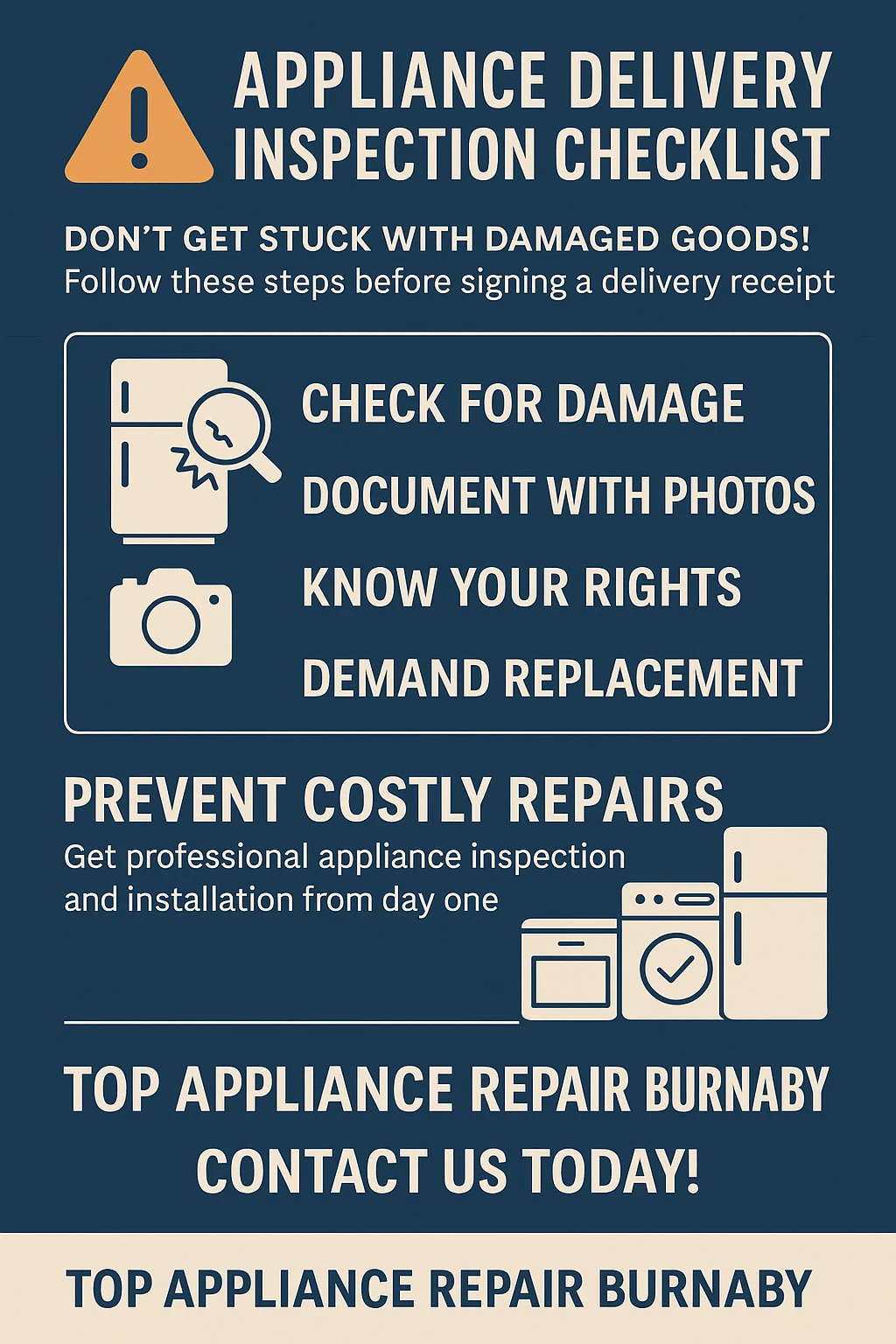
Wondering what to check when your shiny new appliance arrives at your doorstep? Get ready to become your own quality inspector – we’ll walk you through exactly how to spot damage, document everything like a pro, and know when to demand that replacement without hesitation!
Picture this: you’ve just dropped serious cash on that dream refrigerator or the washing machine that’s going to change your laundry game forever. The delivery truck pulls up to your Burnaby home, and you’re practically bouncing with excitement. But hold up – before you start planning where to put all those frozen pizzas or which load of laundry to tackle first, there’s some detective work to do. The difference between appliance delivery bliss and a months-long nightmare of repairs, returns, and headaches often comes down to those crucial first fifteen minutes when the delivery team is still in your driveway.
Here’s the tea: appliance damage during delivery happens way more often than you’d think – we’re talking anywhere from 3% to 20% of all deliveries, depending on who’s doing the shipping and handling. That’s not just a scratch here or a dent there; we’re talking about real problems that can affect how your appliance works, looks, or lasts. And once that delivery slip is signed and the truck drives away? Your leverage to demand immediate replacement drops faster than your phone battery on a busy day.
Whether you’re in the Metrotown area dealing with a condo delivery or out in the Burnaby Heights with a house full of stairs, knowing how to inspect your new appliances properly isn’t just smart – it’s essential for protecting an investment that could easily run into thousands of dollars and serve your household for the next decade.
Key Outtakes:
- Never sign delivery paperwork until you’ve completed a thorough visual and functional inspection of your appliance while the delivery team is still present
- Document any damage immediately with detailed photographs and written notes on the delivery slip, forcing the delivery team to acknowledge and sign off on observed problems
- Understand the difference between acceptable cosmetic damage (hidden dents, minor scratches) and replacement-worthy issues (operational problems, visible damage, seal compromises)
- Most retailers provide only 48-hour windows for reporting damage, making immediate action critical for preserving your consumer protection rights
- Prepare your delivery space, pathways, and documentation tools before the truck arrives to maximize inspection time and minimize delivery complications
Understanding the Delivery Damage Reality

Let’s get real about what we’re dealing with here. When you order a major appliance, you’re not just buying a dishwasher or dryer – you’re entering into a complex logistics chain that involves warehouses, trucks, multiple handlers, and a final delivery team who may be rushing through their route to hit their quotas. Each step of this journey presents opportunities for your precious new appliance to get knocked around, dropped, scratched, or worse.
The statistics are honestly pretty sobering. Industry data shows that appliance damage occurs in 3-9% of deliveries, though some sources report rates climbing as high as 20% for items shipped through certain online retailers. That means if you’re ordering appliances for a full kitchen renovation, there’s a decent chance at least one item is going to show up with some kind of problem. The most commonly damaged appliances? Refrigerators and washing machines, mainly because they’re heavy, awkwardly shaped, and have delicate exterior finishes that show every ding.
But here’s what really gets my blood pressure up – the timing element. Most major retailers, including The Home Depot and other big-box stores, give you exactly 48 hours (and that’s business days, not including weekends) to report any damage or defects. Miss that window, and you’re basically stuck with whatever showed up, regardless of how banged up it is. This isn’t some arbitrary policy designed to make your life difficult; it’s because once an appliance has been in your home for more than a couple days, it becomes nearly impossible to determine whether damage occurred during shipping or after delivery.
The financial implications here are no joke. We’re talking about appliances that can easily cost $1,000 to $5,000 or more, and if you accept a damaged unit, you’re potentially looking at reduced functionality, shortened lifespan, or straight-up embarrassment every time someone sees that obvious dent in your brand-new kitchen. Plus, damaged appliances have virtually no resale value, so if you decide to upgrade or move in a few years, that damage is going to cost you again.
What makes this whole situation even trickier is that delivery teams are typically paid per delivery, not by the hour. They have every incentive to get in and out of your home as quickly as possible, which means they’re not going to volunteer extra time for thorough inspections. They’ll unbox your appliance, maybe run a quick function test, and have that clipboard in your face asking for a signature before you’ve even had a chance to walk around the unit and check for problems.
Pre-Delivery Preparation: Setting Yourself Up for Success

Smart preparation starts weeks before that delivery truck shows up in your driveway. This isn’t just about clearing a path from your front door to the kitchen – though that’s definitely part of it. We’re talking about turning yourself into an appliance delivery ninja who’s ready for anything the day might throw at you.
First things first: measurements, measurements, measurements. I cannot stress this enough – the number of delivery disasters I’ve heard about that could have been prevented with a simple tape measure is honestly heartbreaking. You need to measure not just the final installation space, but every single doorway, hallway, stairwell, and tight corner your appliance needs to navigate. That includes accounting for door knobs, wall sconces, handrails, and any other protrusions that might interfere with moving a large, heavy box through your home.
Here’s a pro tip that most people miss: measure with the appliance doors open, especially for refrigerators. That beautiful French-door fridge might fit through your hallway just fine when it’s closed, but if you can’t actually open the doors once it’s installed, you’ve got a very expensive and very useless kitchen decoration. The same goes for front-loading washers and dryers – make sure you have enough clearance not just to fit the unit, but to actually use it once it’s in place.
Next up: pathway preparation. Your delivery pathway needs to be completely clear – and I mean completely. No area rugs that could slip underfoot, no furniture that “won’t really be in the way,” no shoes kicked off by the door that someone could trip over. Think about this from the perspective of two people carrying a 200-pound refrigerator through your home. Every obstacle is a potential disaster waiting to happen, either for your appliance or for the people carrying it.
For our Burnaby folks dealing with winter deliveries, this means snow and ice removal the night before, not the morning of delivery. Those delivery trucks aren’t going to wait around while you shovel your driveway, and delivery teams aren’t going to risk injury navigating icy walkways. Salt or sand your pathways if needed, and make sure outdoor lighting is working if your delivery is scheduled for early morning or late afternoon.
Now, let’s talk about the inspection toolkit you need to have ready. This isn’t elaborate stuff, but having it organized and easily accessible can make the difference between catching problems and missing them. You’ll want your phone or camera charged and ready for photographs, a tape measure for documenting any damage dimensions, good lighting (a flashlight or LED headlamp if needed), the original order paperwork and receipts, a notepad and pen for written documentation, and leak detection paper or parchment paper to place under water-using appliances.
One thing that catches a lot of people off guard is the infrastructure requirements. Delivery teams aren’t electricians, plumbers, or carpenters. If your new electric range needs a 220V outlet and you’ve only got a standard 110V available, the delivery stops right there. If your gas dryer needs a gas line that doesn’t exist, same problem. Major appliance manufacturers and retailers are very clear that all electrical, plumbing, and gas connections must be properly installed and code-compliant before the delivery team arrives.
The Critical Pre-Signature Inspection Protocol

This is where the rubber meets the road, folks. The inspection you do before signing that delivery paperwork is your single most powerful tool. Once your signature is on that line, you’re essentially telling the company, “I accept this appliance in its current condition.” Reversing that acceptance can be a huge uphill battle. So, let’s break down exactly what you need to do, step-by-step, while the delivery team is still on site (and probably tapping their feet impatiently).
Step 1: Inspect the Box Before It’s Opened
Your inspection starts the moment the appliance comes off the truck. Look at the box itself. Is there any visible damage? Rips, punctures, crushed corners, or water stains are all major red flags. If a forklift tine has punched a hole through the side of the box, you can bet there’s a corresponding dent in your appliance. Take photos of any and all damage to the packaging before the delivery team even thinks about opening it. This establishes that the damage likely occurred in transit, not in your home.
Step 2: The 360-Degree Visual Sweep
Once the appliance is unboxed, it’s time for a detailed visual inspection. Don’t just give it a quick once-over. Get down on your hands and knees, use your phone’s flashlight, and examine every single surface – front, back, top, and sides. You’re looking for:
- Dents and Dings: These are the most common issues. Pay special attention to corners and edges, which are most vulnerable. Even a small dent on the front of a stainless steel fridge can be an eyesore you’ll have to live with for years.
- Scratches and Scuffs: Look for deep scratches that go through the paint or finish, not just surface scuffs that can be buffed out. Run your fingernail over a scratch; if it catches, it’s a problem.
- Cracks: Check any glass or plastic components carefully. This includes control panels, ice/water dispenser trays, and the glass on oven doors or washer lids.
- Misalignment: Are the doors hanging straight? Do they open and close smoothly without rubbing or catching? Check the seals around refrigerator and freezer doors to ensure they make a tight, even connection all the way around. A compromised seal means your fridge will have to work harder, costing you money on your electricity bill.
Take clear, well-lit photos of any imperfections you find, from multiple angles. It’s helpful to include a coin or your finger in the shot to give a sense of scale.
Step 3: The Internal and Functional Check
Now, open it up. The inside is just as important as the outside. For a refrigerator, check for cracked shelves, broken drawers, or missing components. For a washer or dryer, look inside the drum for any scratches or damage. For a stove, check the cooktop for cracks and make sure the oven racks are all present and fit correctly.
If possible, have the delivery team plug the appliance in. This is a non-negotiable step. You need to see if it powers on. Do the lights come on? Does the control panel light up? Can you hear the compressor kick in on a refrigerator? For a washer, you don’t need to run a full cycle, but you should at least see if the drum will spin for a moment. This quick functional test can uncover “concealed damage” – internal problems that aren’t visible from the outside.
Step 4: Document Everything on the Paperwork
This is the most critical step. If you find any damage, no matter how minor, you must note it on the delivery receipt or Bill of Lading (BOL) before you sign it. Do not let the delivery driver rush you or tell you to “just call customer service.” Be specific. Instead of writing “damaged,” write “Large 3-inch dent on upper right-hand side of refrigerator door” or “Deep 6-inch scratch on left side panel.”
After you’ve written your notes, take a picture of the signed paperwork with your notes clearly visible. Then, and only then, should you sign it. If the delivery driver gives you any pushback, stand your ground. Insist that they also sign or initial next to your notes to acknowledge that they saw the damage you documented. This piece of paper is your proof.
Refuse or Accept? Making the Call

So, you’ve found a problem. Now what? Do you refuse the delivery outright, or do you accept it and file a claim? The answer depends on the type and location of the damage.
You should almost always REFUSE the delivery if:
- There is any functional damage. If the appliance doesn’t power on, makes a strange noise, or has a key feature that doesn’t work, do not accept it. It’s not your job to diagnose or repair a brand-new, broken appliance.
- The damage is on a major, visible surface. A big dent right in the middle of your stainless steel refrigerator door is not something you should have to live with. Refuse it. A crack in the glass cooktop? Refuse it.
- Seals are compromised. If the rubber gasket around a refrigerator, freezer, or oven door is torn or doesn’t seal properly, refuse the delivery. This will affect the appliance’s efficiency and performance.
- The damage feels structural. If the frame seems bent or the unit doesn’t sit level and stable, that’s a major red flag.
When you refuse a delivery, the delivery team has to take the appliance back with them. This is the cleanest, fastest way to get a replacement. It forces the retailer to immediately process the return and schedule a new delivery with an undamaged unit.
You might consider ACCEPTING the delivery (after documenting everything!) if:
- The damage is purely cosmetic and in a hidden location. A small dent on the back of the refrigerator that will be against a wall, or a scratch on the side of a dryer that will be sandwiched between the washer and a wall, is often not worth the hassle of a refusal.
- The retailer offers a significant discount. If the damage is minor and cosmetic, you can call the retailer’s customer service line *while the delivery team is still there* and try to negotiate a partial refund. Sometimes you can get 10-25% off for accepting a “scratch and dent” item. Get the discount agreement in writing (an email confirmation is fine) before you let the delivery team leave.
The golden rule is: when in doubt, refuse it. It’s far easier to deal with a refused delivery than it is to try and get a replacement for a damaged appliance that’s already installed in your home.
Frequently Asked Questions
Q: What if I don’t notice the damage until after the delivery team leaves?
A: You need to act immediately. Most retailers have a very strict 48-hour window for reporting concealed damage. Call the customer service line right away, and be prepared to send them the photos you took during the inspection. The longer you wait, the harder it will be to prove the damage occurred during delivery.
Q: The delivery driver is in a huge rush and won’t let me inspect the appliance properly. What should I do?
A: Do not be intimidated. You have the right to inspect your property before you sign for it. Politely but firmly state that you need a few minutes to complete your inspection before signing. If they refuse to wait, you can either refuse the delivery on that basis or write “Possible concealed damage – unable to inspect before driver left” on the delivery slip before you sign.
Q: The box was in perfect condition, but the appliance inside was damaged. How does that happen?
A: This is called concealed damage and it’s frustratingly common. It usually means the damage happened at the factory or in the warehouse before the appliance was even boxed up. Your inspection protocol is the same, but it becomes even more important to report it within that 48-hour window, as the retailer will be dealing with the manufacturer on their end.
Q: Should I tip the appliance delivery guys?
A: Tipping is not required, but it’s a nice gesture, especially if the delivery was complex (lots of stairs, tight corners, etc.) and the team was professional and patient during your inspection. A tip of $10-$20 per person is generally considered appropriate. However, never let a potential tip stop you from conducting a thorough inspection.
Wrapping Up
That initial inspection when your new appliance arrives isn’t just a formality; it’s your single best line of defense in a process where things can and do go wrong. By preparing your home beforehand, having your inspection tools ready, and knowing exactly what to look for, you shift the power dynamic. You’re no longer just an excited customer; you’re an informed consumer protecting a significant investment.
Remember, the goal isn’t to be difficult – it’s to be diligent. A professional delivery team will understand and respect your need to verify the condition of your purchase. By documenting everything on the delivery paperwork, you create an undeniable record that protects you from the lengthy and frustrating process of trying to prove damage after the fact. So take a deep breath, ignore the pressure to sign quickly, and give your shiny new appliance the thorough once-over it deserves. Your future self—and your wallet—will thank you.